Palaces and heritage
Stepwells of Bundi: Raniji ki Baori, Dabhai and Nagar Sagar
Written by Kota Rajasthan Editorial Team · Updated
The stepwells of Bundi are the town’s quiet masterpieces. Bundi sits in a narrow valley in the hills, with no great river at its door, and for centuries its rulers, queens and merchants answered the problem of water with stone: deep baoris reached by long flights of steps, and square kunds whose stairs zigzag down all four sides. Rajasthan Tourism calls Bundi “the city of stepwells”, and Wikipedia’s article on the town counts more than fifty. This guide covers the three you should not miss, how they worked, and how to see them in a morning from Kota, 36 km away.
Why Bundi built so many stepwells
Hadoti has a short monsoon and a long dry season. Rain falls hard for a few months and then the land dries out. A stepwell solved two problems at once: it reached down to groundwater that stayed long after the surface ponds had gone, and its steps let people walk down to the water whatever the level. Building one was also an act of charity and prestige. Queens, nobles and merchants paid for stepwells as public gifts, and many have small shrines in their walls.
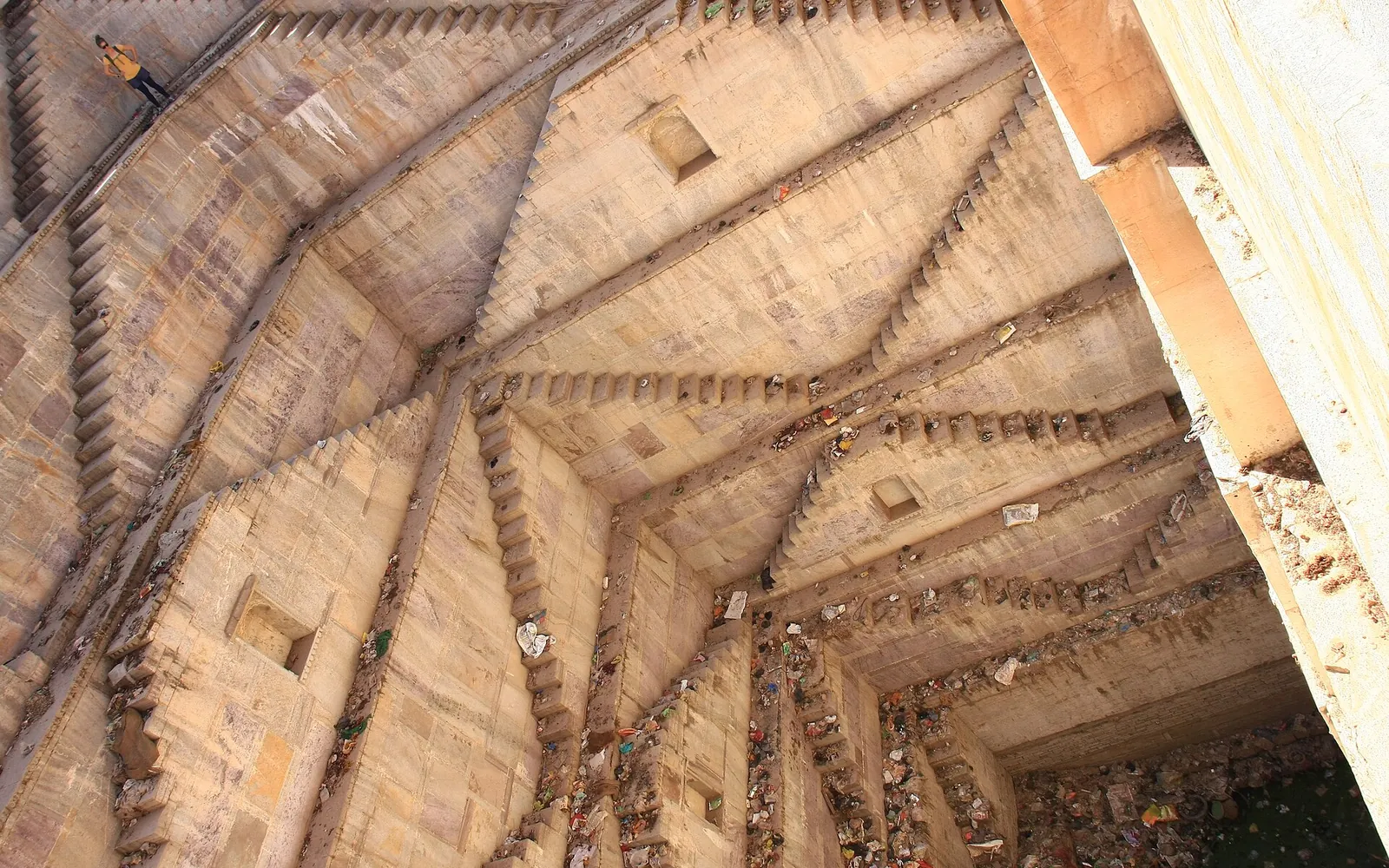
Wikipedia’s account notes that the wells became places of gathering and worship as well as water sources, and that many fell into disrepair in the colonial period, when piped water and neglect made them seem unnecessary. Several are now cleaned and protected; others are still choked with rubbish, as the photograph at the top of this page shows.
Baori and kund: two kinds of stepwell
- Baori (or bawdi): a long, narrow stepped corridor that descends in stages to a well shaft at the far end. The sides are lined with pillared galleries, and the deepest levels stay cool even in May.
- Kund: a stepped tank, usually square or rectangular, with flights of steps on all sides meeting at the water in the middle. Seen from above, the crossing stairs form a geometric pattern.
Bundi has fine examples of both, a few minutes’ walk apart.
Raniji ki Baori (1699)
The queen’s stepwell is the most famous in Bundi and one of the finest in India. It was built in 1699 by Rani Nathavati, a queen of Rao Raja Anirudh Singh. Anirudh Singh died in 1696, so the work was completed in the reign of their son Budh Singh; sources differ on how to describe her, but agree on the date.
The baori is about 46 m deep and several storeys high. You enter through a narrow gate under a high arch and descend past galleries with carved pillars and brackets. Rajasthan Tourism draws attention to the carved elephants, their trunks curled inwards as if they had just drunk from the well, and Wikipedia’s article mentions stone elephants facing each other at the corners and carvings of the avatars of Vishnu. Our Raniji ki Baori page has full visitor details.
Dabhai Kund (Jail Kund)
A short walk from the old town, Dabhai Kund is a vast stepped tank shaped like an inverted pyramid. Rajasthan Tourism calls it the largest of its kind in Bundi and praises the carving on the steps leading down to the water. It is also known as the Jail Kund. The best view is from the top edge, where the criss-crossing stairs of all four sides line up into a pattern; walk down a few flights to feel the scale.
The twin Nagar Sagar Kunds
Just outside the Chauhan Gate of the old city stand the two Nagar Sagar Kunds, a matching pair of stepped tanks. Rajasthan Tourism says they were built to provide water during times of famine. The western kund appears in the photograph above: steep zigzag stairs descend on every side to a small square of water at the bottom. They are among the easiest stepwells in Rajasthan to see, right in the bustle of the town, and are worth visiting even if you only have half an hour.
Other water heritage in Bundi
The stepwells were only part of a whole water system. Nawal Sagar lies in the heart of the town below the palace, and Jait Sagar, with Sukh Mahal on its bank, fills the valley to the north. Inside Taragarh Fort there are large reservoirs cut into the hill. Kota has its own, smaller collection of stepwells too: see the baoris of Kota.
A half-day stepwell walk
- Start at Raniji ki Baori when it opens, before the day warms up.
- Walk to the Nagar Sagar Kunds at the Chauhan Gate, a short walk away.
- Continue to Dabhai Kund, a short auto-rickshaw ride or a longer walk.
- Finish at Nawal Sagar for the view of Bundi Palace above the water, then climb to the palace and the Chitrashala if you have time.
Local guides in Bundi can show you smaller, less-visited stepwells in the lanes of the old town. Ask at your guesthouse or the tourist office.
Tips for visiting
- Wear shoes with grip. The steps are steep and worn smooth, and there are rarely railings.
- Do not go down into the water. Depths are unknown and the lower steps can be slippery.
- Dress modestly and be respectful at the small shrines inside the wells.
- Photography: morning light reaches the bottom of the kunds best. A wide-angle lens helps with the geometry.
- Monsoon visits: after good rains the wells hold water and look as they were meant to; see Kajli Teej in Bundi for a festival at that time of year.
Getting there from Kota
Bundi is about 36 km from Kota by road, under an hour by car or taxi, and there are frequent buses. Combine the stepwells with the palace in a long day trip, or follow our weekend in Bundi itinerary. For the story behind the town’s monuments, read the history of Bundi.
Frequently asked questions
How many stepwells are there in Bundi?
Wikipedia's article on Bundi says the town contains over 50 stepwells. Only a handful are maintained for visitors; the best known are Raniji ki Baori, Dabhai Kund and the Nagar Sagar Kunds.
What is the difference between a baori and a kund?
In Rajasthan a baori (or bawdi) is usually a stepwell reached by a long flight of steps down a narrow shaft, often with pavilions on each level. A kund is a stepped tank, usually square, with steps on all sides descending to the water.
Who built Raniji ki Baori?
Rani Nathavati, a queen of Rao Raja Anirudh Singh of Bundi, built it in 1699. Anirudh Singh died in 1696, so the stepwell was completed in the reign of their son Budh Singh.
Is there an entry fee for Bundi's stepwells?
Arrangements change, and some Bundi monuments are ticketed. Check at the site or with the tourist office rather than relying on old figures; this guide does not quote fees.
When is the best time to see the stepwells?
Late in the monsoon and just after it (August to October), when they hold water, or in the cool season from November to February. Morning light is best for photographs.
Sources
Editorial team
The KotaRajasthan.net team writes about the places, history and festivals of Kota and Hadoti, and corrects pages when readers point out changes.