Wildlife and the Chambal
Indian Skimmer on the Chambal: How to See This Rare Bird
Written by Kota Rajasthan Editorial Team · Updated
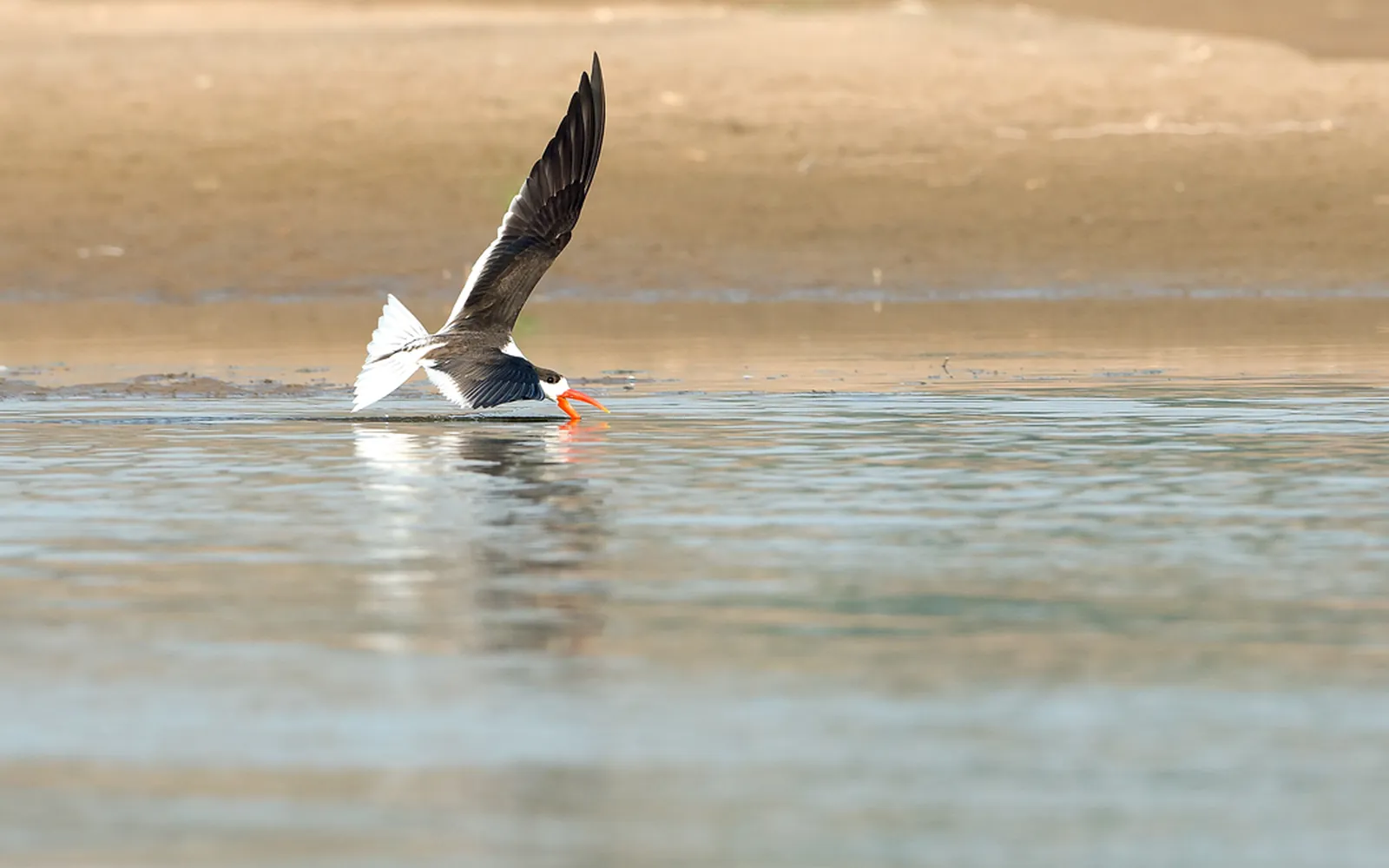
The Indian skimmer is one of the most striking birds you can hope to see on the Chambal, and one of the rarest. Black above, white below, with a large orange bill whose lower half is longer than the upper, it hunts by flying low over calm water with its bill open, ploughing a thin line across the surface. The Chambal is one of the places where this endangered species still breeds, which makes a river trip from Kota a real chance to see it. This guide explains how to recognise it, how it lives, and how to watch it without harming it.
What the Indian skimmer is
The Indian skimmer (Rynchops albicollis), once called the Indian scissors-bill, is one of only three skimmer species in the world. The others are the black skimmer of the Americas and the African skimmer. All three belong to the gull and tern family and share the same remarkable bill: a short upper mandible and a longer, flexible, knife-like lower mandible.
The bird is about 40 to 43 cm long with a wingspan of around 108 cm, so it looks tern-like in flight, with long, pointed wings. Adults have a black cap and black upperparts, a white forehead, collar and underparts, red legs and an orange bill with a yellow tip. Birds outside the breeding season are duller and browner, and juveniles are grey-brown with an orange-brown, dark-tipped bill. Interestingly, young birds’ bills look fairly normal at first; the lower mandible lengthens as they grow.
It is mostly silent, but it can give a high, nasal kyap-kyap call.
How it feeds
Skimming is the bird’s signature move. It flies low and steady over smooth water with its bill open, the lower mandible cutting the surface. When the lower bill touches a fish, the bird snaps the upper mandible shut with a quick movement of the head. It feeds mainly on fish, with some small crustaceans and insect larvae. Skimmers often hunt in small flocks, frequently with terns, and they are active at dusk and can feed well into the night.
Because the technique needs calm, open water, skimmers favour wide rivers, lakes and estuaries. A wind-ruffled river is much harder to hunt on, which is one reason early mornings and evenings are good times to look.
Breeding on the sandbanks
The breeding season is mainly from March to May. Skimmers nest in colonies of up to about 40 pairs, usually on islands or sandy spits in rivers, often in the company of river terns and other birds. The nest is just a scrape in open sand, chosen so the sitting bird can see predators coming. Clutches are of three to five buff or whitish eggs with brown blotches.
The birds incubate more in the cooler parts of the day and may leave the nest in the midday heat. Adults are reported to soak their belly feathers in the river to cool the eggs. Some skimmers even lay eggs in the nests of river terns.
Known breeding colonies include the Chambal river area, the same sandbank landscape that is vital for the gharial. That overlap is no accident: both species depend on open, undisturbed sandbanks in a clean, flowing river.
Why it is endangered
The Indian skimmer was once widespread on the rivers of the Indian subcontinent and on the river systems of Myanmar and the Mekong. Records from Laos, Cambodia and Vietnam are mostly from the 19th century. Today the population is mainly in India and Pakistan and is estimated at about 6,000 to 10,000 birds. Its range is increasingly fragmented, and the IUCN classes it as Endangered.
The main threats are:
- Loss and degradation of sandbanks, including sand mining, farming on river islands and changes in river flow from dams and water extraction.
- Disturbance at nesting colonies by people, boats, cattle and dogs. A single disturbance can expose eggs to heat or predators.
- Pollution of rivers and wetlands.
Most colonies are unprotected, but some lie in reserves such as the National Chambal Sanctuary, which is also recognised as an Important Bird Area. The sanctuary lists the skimmer among its threatened birds, together with species such as the sarus crane and Indian courser.
Where and when to look near Kota
Kota sits on the Chambal river, and the river through and around the city is part of the National Chambal Sanctuary. The best way to look for skimmers is from a boat with a licensed operator; our guide to the Chambal river safari explains how trips work, and the wildlife safaris near Kota hub lists the other options.
Some practical points:
- Season: the cool months from about November to March are comfortable and good for river birds generally; in spring you may see breeding behaviour, but that is exactly when birds need the most space.
- Time of day: early morning and late afternoon light is best, and skimmers often feed towards dusk.
- Where on the water: watch calm stretches near sandbanks and islands, and look for terns, which skimmers often accompany.
- Expectations: sightings are never guaranteed. Numbers and locations change with water levels, so ask the forest department or your boatman where birds have been seen recently.
If you are a keen birder, combine the river with the grasslands of Sorsan and the wetland at Bardha Dam for a fuller picture of Hadoti’s birds.
How to watch without disturbing them
Skimmer colonies are fragile, so the rules are simple:
- Never land on, walk across or camp on sandbanks with nesting birds.
- Ask your boatman to keep a wide berth around colonies, especially from March to May.
- Use binoculars or a long lens instead of moving closer. If birds take off or call in alarm, you are too close.
- Do not use drones near birds or nesting islands.
- Take all litter away and keep noise down on the water.
Telling it apart from similar birds
On the Chambal the skimmer is most often confused with terns. River terns are grey above with a pointed yellow bill whose two halves are the same length; skimmers are darker above, heavier, and the big orange bill with its longer lower half is unmistakable once you see it. In flight, the skimmer’s habit of flying low with the bill in the water is the giveaway.
Photographing skimmers responsibly
The classic photograph is a skimmer in profile, bill slicing the surface, with a reflection below. You get it with patience and a long lens from a stationary boat, not by chasing birds. Low, soft light helps, and a fast shutter speed freezes the wingbeats.
More on the Chambal
The skimmer is part of a river ecosystem shaped by history as much as nature. Read how the dams upstream changed the river in the Chambal Valley Project, or start with an easy riverside walk in the Chambal Garden before you take to the water.
Frequently asked questions
What is special about the Indian skimmer's bill?
Its lower mandible is longer than the upper one and knife-like. The bird flies low with its bill open, cutting the water with the lower half; when it touches a fish, the upper bill snaps shut.
Is the Indian skimmer endangered?
Yes. The IUCN classes it as Endangered. Its population is estimated at about 6,000 to 10,000 birds and is declining because of habitat loss, pollution and disturbance.
Can I see Indian skimmers near Kota?
The Chambal is one of the species' known breeding areas, and boat trips in the National Chambal Sanctuary are the most likely way to see one in this region. Sightings are never guaranteed and vary by stretch and season, so ask the forest department or a licensed boatman where birds are being seen.
When do Indian skimmers breed?
Mainly from March to May, in colonies on open sandbanks and river islands, often alongside terns. Nests are simple scrapes in the sand, so visitors must not land on or walk across nesting banks.
How do I tell an Indian skimmer from a tern?
Look at the bill. A skimmer's bill is large, bright orange with a yellow tip and has a longer lower half; a river tern's bill is yellow and pointed, with both halves the same length. The skimmer also has a black cap and back over white underparts and a white collar.
Sources
Editorial team
The KotaRajasthan.net team writes about the places, history and festivals of Kota and Hadoti, and corrects pages when readers point out changes.