Hadoti day trips
Ramgarh Crater and Bhand Devra Temple: Baran Day Trip
Written by Kota Rajasthan Editorial Team · Updated
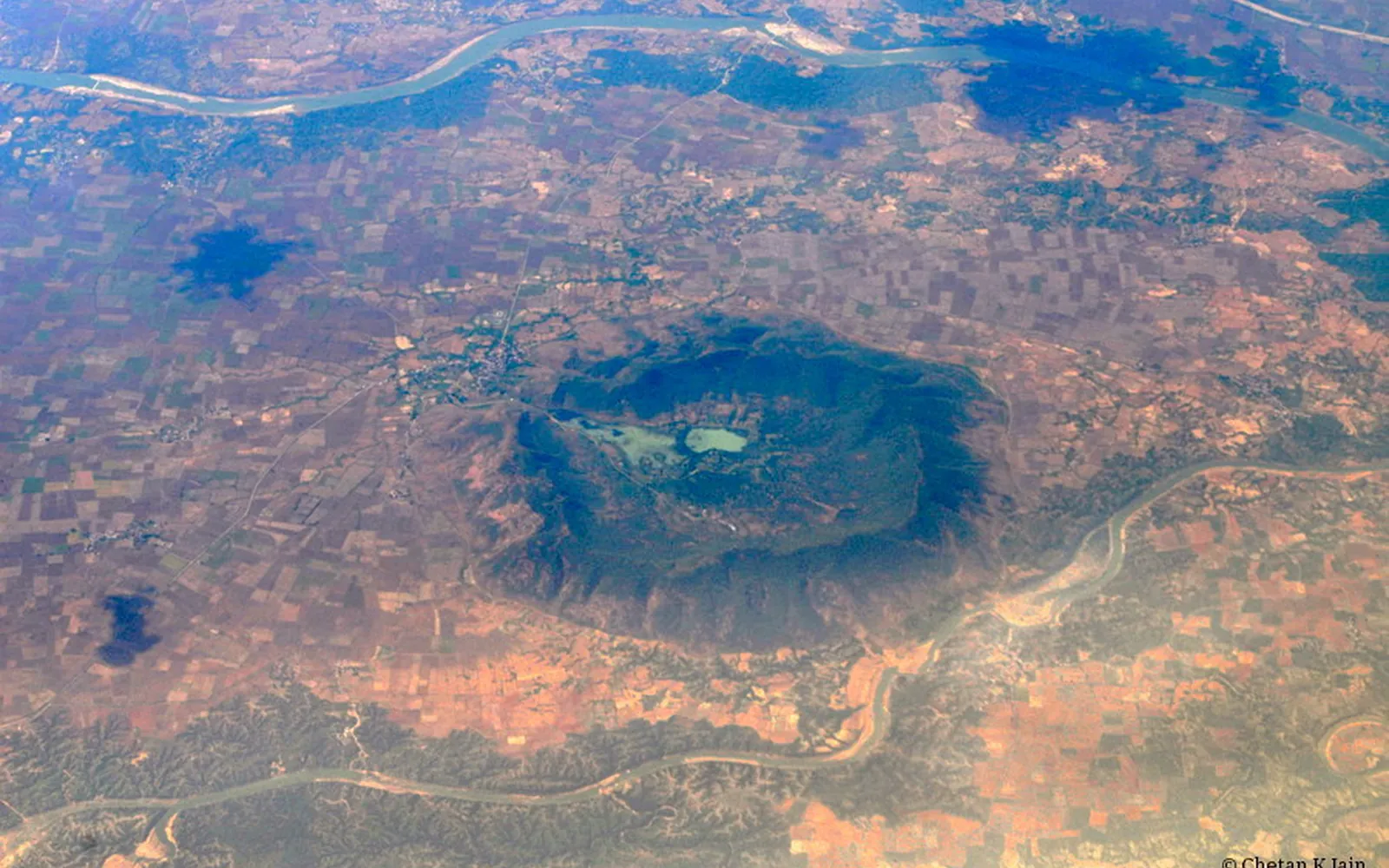
The Ramgarh crater and Bhand Devra temple in Baran district make one of the strangest and most rewarding day trips from Kota. A ring of hills about 3.2 km across rises out of the flat farmland near Ramgarh village; geologists now classify it as a meteorite impact crater, and the Geological Survey of India declared it a National Geological Monument in 2018. Inside the ring, beside a small pond, stands the Bhand Devra temple, a 10th-century Shiva temple whose sculpture has earned it the nickname “mini Khajuraho of Rajasthan”. Science, ruins and a quiet rural landscape come together in one place.
The crater: what geologists say
The crater rim stands 150 to 200 m above the surrounding plain, and a small central hill rises from its floor. Its origin was argued over for more than a century:
- 1869: geologist F. R. Mallet of the Geological Survey of India visited and described the structure.
- Early 20th century: the GSI treated it as an intrusion, a dome pushed up by molten rock from below.
- 1972 onwards: A. R. Crawford proposed an impact origin after finding shatter cones, and a 452 m borehole drilled in 1981-82 found no volcanic or intrusive rock.
- 2020: a new study provided stronger evidence, and the Earth Impact Database listed Ramgarh as a confirmed impact crater, one of very few in India.
The age is still debated. Uranium-lead dating points to a very old event, hundreds of millions of years ago, while Rajasthan Tourism’s page repeats a much younger popular figure. Treat any single date you hear on site with caution.
Bhand Devra temple
Rajasthan Tourism places the Bhand Devra temple about 40 km from Baran town, on the banks of a small pond inside the crater, and says it dates back to the 10th century. It is dedicated to Shiva and built in the style often compared to Khajuraho, with bands of figure sculpture, including erotic panels, on its walls. Architectural historians list it among the examples of the Bhumija style, in which the spire is made of rows of small spires rising in tiers; our guide to Hadoti temple architecture explains what that means and what to look for.
The temple is weathered and partly restored. Look up inside the hall: the pillars carry figures on their brackets, and the ceiling steps up in carved, square-and-octagonal layers to a central lotus. The outer walls reward a slow walk round with sculptures of deities, musicians, couples and animals.
What to see at Ramgarh Crater and Bhand Devra Temple
- The crater rim, best appreciated as you drive in across the plain and through the gap in the hills
- Bhand Devra temple and its carved hall ceiling
- The pond beside the temple
- The surrounding dry forest, where palash (flame of the forest) flowers in late winter
Baran’s district museum and other temples, such as the 9th-10th century Bansthuni temple on the Shahabad road 24 km from Baran (Rajasthan Tourism), can be added on the way.
Visiting Ramgarh Crater & Bhand Devra Temple: practical details
| Detail | Information |
|---|---|
| Where | Hadoti Region, Baran district |
| Distance from Kota | About 110 km |
| Best time to visit | October to March |
| Timings | Daylight hours |
| Entry | Free / nominal |
| Getting there | From Kota, drive about 110 km via Baran toward Ramgarh village; the crater and temple are reached by rural roads, best with a private vehicle. |
Distances are approximate road distances. Timings and entry charges change from season to season, so confirm them locally or with the district tourist office before you set out.
Combine Ramgarh Crater & Bhand Devra Temple with nearby places
- Shergarh Fort: An old fort on the banks of the Parvan River in Baran district, with layers of Hindu, Jain and Islamic history.
- Shahabad Fort: One of the strongest and most remote forts of the Hadoti region, set on a hill amid the forests of Baran district.
- Kakoni Temples: An ancient, largely ruined temple complex on the banks of the Parvan River in Baran district, rich in medieval sculpture.
- Baran tourist places: Routes from Kota to the crater, forts, temples and grasslands of Baran district.
- Sahariya tribe: The forest community of Baran district and their Sitabari fair.
- Protected monuments in Hadoti: The ASI-listed sites of Baran and the rest of the region.
Frequently asked questions
How do I get to Ramgarh Crater & Bhand Devra Temple from Kota?
From Kota, drive about 110 km via Baran toward Ramgarh village; the crater and temple are reached by rural roads, best with a private vehicle.
When is the best time to visit Ramgarh Crater & Bhand Devra Temple?
October to March.
What are the timings and entry charges for Ramgarh Crater & Bhand Devra Temple?
Timings: Daylight hours. Entry: Free / nominal. Both change, so check locally before you go.
Is Ramgarh really a meteorite crater?
Its origin was debated for a century, but a 2020 study gave stronger evidence of an impact and the Earth Impact Database now lists it as a confirmed impact crater. The Geological Survey of India declared it a National Geological Monument in 2018.
Why is Bhand Devra called the Khajuraho of Rajasthan?
Because of its 10th-century figure sculpture, including erotic panels, in a style compared with the Khajuraho temples. Rajasthan Tourism calls it the mini Khajuraho of Rajasthan.
Sources
Editorial team
The KotaRajasthan.net team writes about the places, history and festivals of Kota and Hadoti, and corrects pages when readers point out changes.